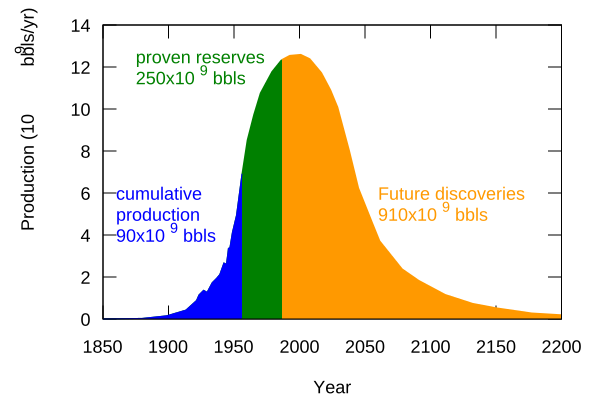
http://en.wikipedia.org/wiki/M._King_Hubbert
Saudi Aramco’s crude oil exports peaked in 2005
Twilight in the Desert:
The Coming Saudi Oil Shock and the World Economy
------------------------Check out the rest of this blog here.


In fact, there isn’t that much of a difference between BP and Lehman Brothers – both have been among the major players in the unregulated $615 trillion OTC derivative market. If BP is forced to file for bankruptcy, it will probably have an even greater negative impact on the financial markets than the Lehman failure caused.
The abandonment of the gold standard in 1971 is closely tied to the massive unemployment the industrialized world has suffered in recent years; Mexico, even with a lower level of industrialization than the developed countries, has also lost jobs due to the closing of industries; in recent years, the creation of new jobs in productive activities has been anemic at best.
The world’s financial press, in which leading economists and analysts publish their work, never examines the relationship between the abandonment of the gold standard and unemployment, de-industrialization, and the huge chronic export deficits of the Western world powers. Might it be due to ignorance? We are reluctant to think so, given that the articles appearing in the world’s leading financial publications are written by quite intelligent analysts. Rather, in our opinion, it is an act of self-censorship to avoid incurring the displeasure of the important financial and geopolitical interests that are behind the financial press.
In this article we discuss the relationship between loss of the gold standard and the present financial chaos, which is accompanied by severe “structural imbalances” between the historically dominant industrial powers and their new rivals in Asia.
It's a story of an industry that may sound familiar.
The buyers think what they're buying will appreciate in value, making them rich in the future. The product grows more and more elaborate, and more and more expensive, but the expense is offset by cheap credit provided by sellers eager to encourage buyers to buy.
Buyers see that everyone else is taking on mounds of debt, and so are more comfortable when they do so themselves; besides, for a generation, the value of what they're buying has gone up steadily. What could go wrong? Everything continues smoothly until, at some point, it doesn't.
Yes, this sounds like the housing bubble, but I'm afraid it's also sounding a lot like a still-inflating higher education bubble. And despite (or because of) the fact that my day job involves higher education, I think it's better for us to face up to what's going on before the bubble bursts messily.
Lots of gold bugs burrow into the precious metal because it's thought to be the ultimate hedge against inflation. Given that the U.S. national debt just passed the $13 trillion mark (or about 90% of GDP), it's not too hard to imagine a dark day of reckoning for the purchasing power of the almighty dollar not too far down the road.
But it turns out that gold isn't really much of an inflation hedge at all, which explains how a big-time deflationist like David Rosenberg, Gluskin Sheff's bearish chief economist and strategist, can be so bullish on the yellow metal.
"The widespread consensus that gold is an effective inflation hedge is not on the mark," Rosie told clients Thursday. "Our statistical analysis shows there to be a fairly loose link even if gold is a store of value. We also know that in the deflationary 1930s, the Sterling price of gold doubled."
Historically minded readers may be saying, "There was a Depression in 1946? I never heard about that." You never heard of it because it never happened. However, the "Depression of 1946" may be one of the most widely predicted events that never happened in American history. As the war was winding down, leading Keynesian economists of the day argued, as Alvin Hansen did, that "the government cannot just disband the Army, close down munitions factories, stop building ships, and remove all economic controls." After all, the belief was that the only thing that finally ended the Great Depression of the 1930s was the dramatic increase in government involvement in the economy. In fact, Hansen's advice went unheeded. Government canceled war contracts, and its spending fell from $84 billion in 1945 to under $30 billion in 1946. By 1947, the government was paying back its massive wartime debts by running a budget surplus of close to 6 percent of GDP. The military released around 10 million Americans back into civilian life. Most economic controls were lifted, and all were gone less than a year after V-J Day. In short, the economy underwent what the historian Jack Stokes Ballard refers to as the "shock of peace." From the economy's perspective, it was the "shock of de-stimulus."
 Rothbard
Smart
Schiff
Hayek
Schumpeter Bastiat
Rothbard
Smart
Schiff
Hayek
Schumpeter Bastiat